

By Jesús Molina
I was not supposed to have that morning free.
Abu Dhabi had me on a tight schedule – music meetings, studio conversations, the kind of purposeful busyness that follows a musician across time zones. But a window opened up, the way windows sometimes do when you stop trying to fill every hour, and someone said: go to the desert. You have time. Just go.
I booked it that same night without overthinking it. That instinct has never let me down.
The drive out to Al Khatim
The 4×4 picked me up at 7:30 in the morning. The city was barely awake – that particular stillness Abu Dhabi holds in the early hours, the towers catching the first light, the roads not yet claimed by the day. I watched the skyline shrink in the window as we drove south-east toward Al Khatim, and somewhere around the thirty-minute mark the buildings simply stopped. The sand took over. And something in me exhaled that I had not realised was held tight.
The drive out is part of the experience. Nobody tells you that. You think the desert begins when you arrive, but it begins on the road – the slow transition, the landscape opening, the sky becoming larger than anything else around you. By the time we reached the dunes I was already in a different state of mind than the one I had left the hotel with.
We drove across the open terrain first – no road, no path, just the 4×4 moving across the surface of the dunes in the early morning quiet. The light at that hour does something to the sand that I was not prepared for. Long shadows, a warmth in the colour that feels almost amber, a softness to everything that disappears the moment the sun climbs higher. I spend a lot of time thinking about texture in music – the difference between a note played with force and the same note played with weight. The desert at 7:30 AM has that second quality entirely. Everything feels intentional. Considered. Like a composition that knows exactly what it is doing.
I took photographs I will never fully share because they do not translate. Some things only exist in the moment of experiencing them.
The camel farm – the part nobody talks about
Then we stopped at the camel farm, and that is where the morning changed for me completely.
I want to be honest about this because I think people underestimate it. Before I went, the camel farm sounded like a pleasant detour – the kind of thing you do because it is on the itinerary, not because you expect it to matter. I was wrong, and I am glad I was wrong.
These are not decorative animals. They are not performing. The camels at Al Khatim carry a kind of unhurried dignity that I found genuinely affecting — a slowness that is not laziness but something closer to patience. The way they move, the way they hold themselves, the way one of them looked at me with a complete absence of urgency while I stood there trying to figure out what I was feeling – it was one of the quieter and more unexpectedly moving moments of my entire trip.
I stood there longer than the schedule probably required. Nobody rushed me. The handlers were generous with their time and their knowledge. The farm smelled of hay and heat and something ancient that I do not have a better word for. As a musician I am always listening for what a space sounds like, and that space sounded like a place that had been exactly what it was for a very long time. There is a particular kind of peace in that. I did not want to leave it.
Dune bashing at Al Khatim – presence, not adrenaline
Dune bashing is the part everyone talks about, and they are right to talk about it – but it earns its reputation for reasons that are harder to explain than they first appear.
The driver, who handled the 4×4 with the calm confidence of someone who has had this conversation with the desert ten thousand times, took us up and over faces that looked nearly vertical from where I was sitting. It is loud and physical and completely absorbing. There is no space inside it for anything else – no rehearsal anxiety, no mental checklist, no awareness of what comes next. You are simply there, inside the moment, because the moment does not give you a choice.
Musicians talk about this. The point where technique disappears and you stop playing the music and start being inside it. I have chased that feeling on stages across twelve countries. I did not expect to find it on the side of a sand dune in Abu Dhabi at nine in the morning, but there it was – that same erasure of self-consciousness, that same pure presence. The desert has its own tempo, and when you are inside dune bashing, you submit to it completely.
The Bedouin camp – feeling at home in the desert
At the camp, someone offered me a kandura and a ghutrah.
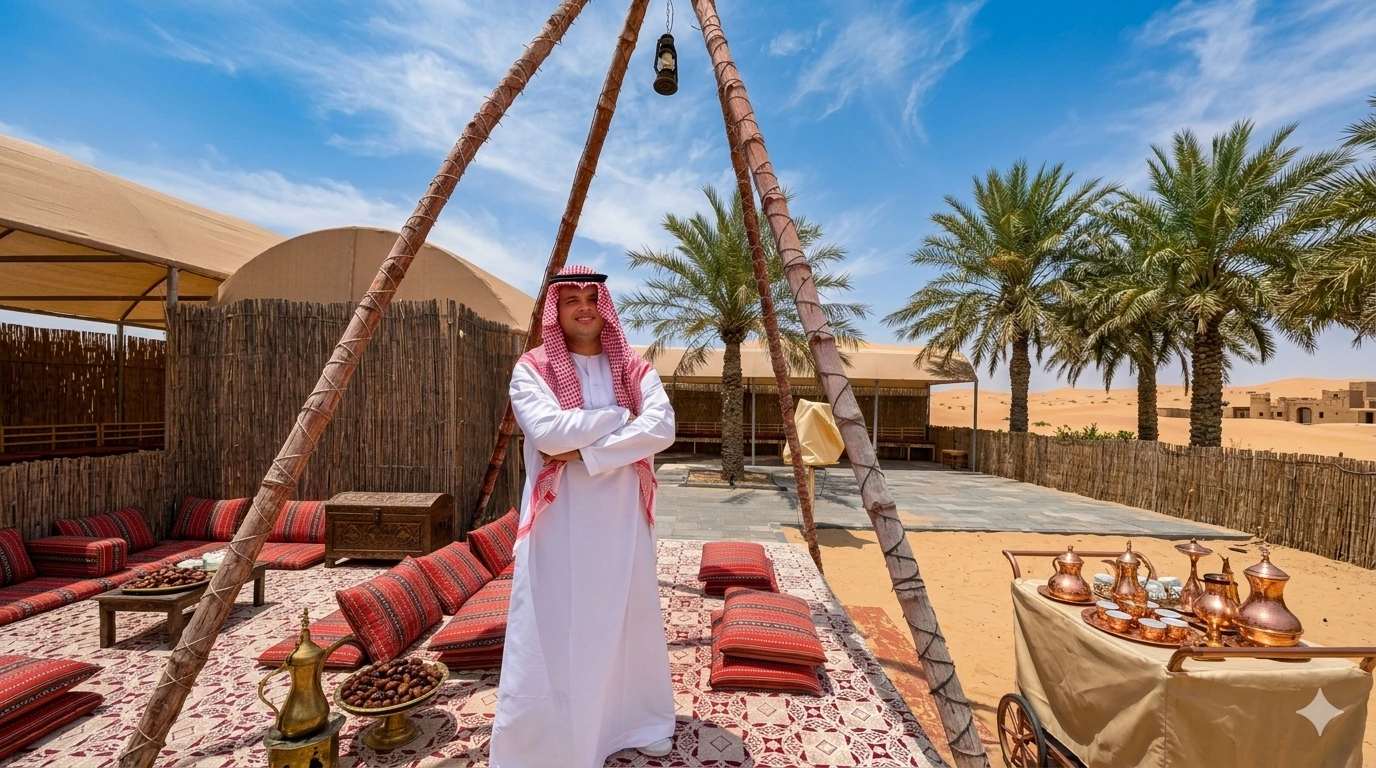
I said yes without hesitating. I put on the white robe and the red-white headdress and stood in the middle of the Bedouin camp – palm trees above me, a lantern hanging from three desert poles, woven cushions and carpets beneath my feet, the reed walls holding the space, the open sky beyond them holding everything else. And I felt, in a way I was not expecting and cannot fully explain, entirely at home.
Not comfortable in the tourist sense. At home in the deeper sense – the feeling of being in exactly the right place at the right moment, fully present, without the need to perform or manage or produce anything. As someone who lives most of their life in some state of performance, that feeling is genuinely rare. I stood there for a while and just let it exist.
They brought Arabic coffee – kahwa, the cardamom-spiced coffee that runs through Emirati hospitality like a musical motif through a composition. Small cups, unhurried refills, dates alongside. I sat on the cushions and drank it and watched the desert beyond the camp walls and thought about nothing in particular, which is something I almost never do.
Back before noon – what the morning safari in Abu Dhabi gives you
I was back in Abu Dhabi before noon. Four hours total. The city received me exactly as I had left it = full schedule, full afternoon, the same meetings and conversations waiting.
But I was different. Not dramatically. Not in the way of a revelation. In the quieter way of someone whose internal tempo has been reset – slowed to something closer to its natural pace, cleared of the accumulated noise of purpose and schedule and expectation. The desert does this. It is not subtle about it, but it is not aggressive about it either. It simply operates at a frequency that is older and steadier than anything you brought with you, and if you are willing to listen, you leave tuned differently.
For a musician who lives inside sound, four hours inside that particular silence was its own kind of composition. One I did not write, but one I will carry.
If you find yourself in Abu Dhabi with a free morning
If you find yourself in Abu Dhabi – for a trip, for a work visit, for a layover with a free morning and the instinct to do something with it – go to the desert. Go early. The morning light is worth it alone, but it is not the only thing.
Book your Abu Dhabi desert safari through Xtreme Sightseeing Tourism. The morning safari in Abu Dhabi starts at AED 250 per person – which, for what it gives you, is not a price at all. They have been running this since 2010 and it shows – not in a polished, packaged way, but in the quieter signs of an operation that genuinely knows what it is doing. The drivers know Al Khatim the way I know a piano. Not from instruction, but from years of honest conversation with it.
The morning safari leaves at 7:30 AM. You will be back before the city has fully decided what kind of day it wants to be. And you will carry something back that was not there when you left – something the desert gives freely to anyone willing to show up early enough to receive it.
Jesús Molina is a Colombian Jazz Pianist, Producer, and Multi-instrumentalist. As a performer, producer, and educator he blends elite musicianship with electronic production and global influences. Find his music and upcoming concerts at jesusmolina.org.
